The Korean War
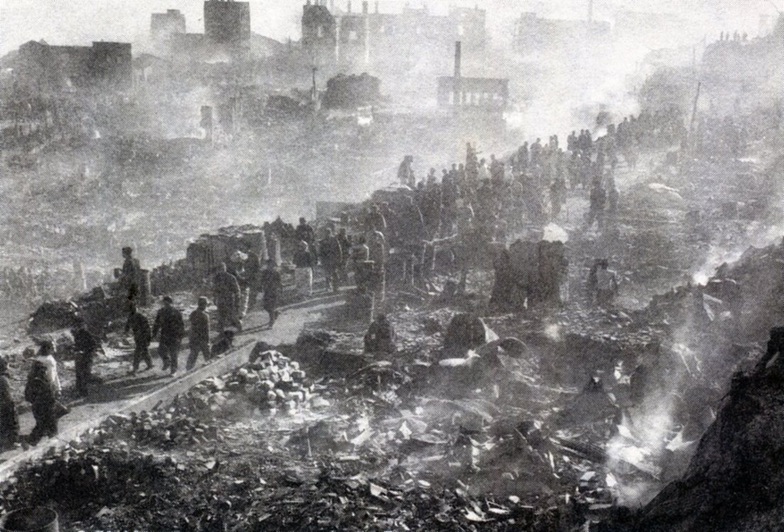
Korean civilians attempt to scavenge a living out of the remains of their post-Korean War world. The Korean War by Max Hastings
|
Korean War veteran recounting the atrocities of the Korean people at the hands of the American military and the anti-Western rhetoric that followed. A State of Mind
On the morning of June 25th, 1950, Kim Il-Sung—aided by Soviet forces—crossed the 38th parallel and invaded South Korea. Kim Il-Sung used Juche to justify his invasion of South Korea, arguing that he needed to take control of the South in order to remove the impurities of Western influence. The anti-Western sentiment and fierce self-reliance of the Juche ideology was formed during this struggle.
|
"It is important also to United States prestige
world-wide, to the future of the United Nations and the North
Atlantic Treaty Organization and to efforts to organize
anti-communist resistance in Asia that Korea not be evacuated
unless actually forced by military considerations, and that
maximum practicable punishment be inflicted on Communist
aggressors."
- Joint Chiefs of the UN to General MacArthur |
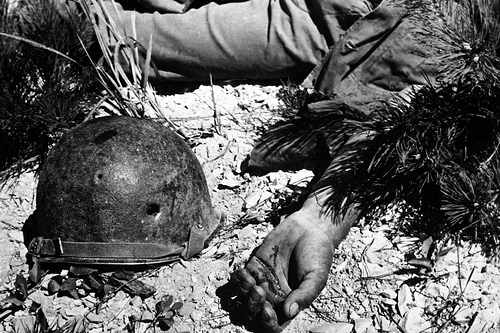
The helmet of a dead US soldier. Click to Enlarge. North Korea, Citizens of the Isolated Country
|
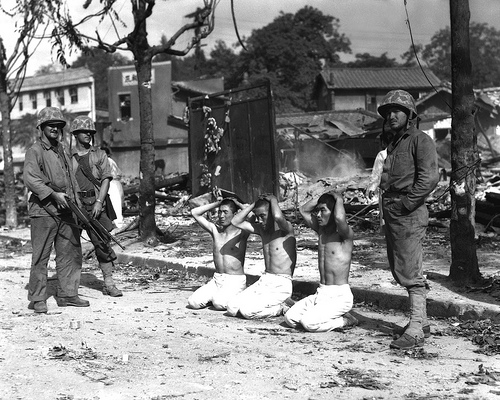
Captured Korean troops. Click to Enlarge. North Korea, Citizens of the Isolated Country
|
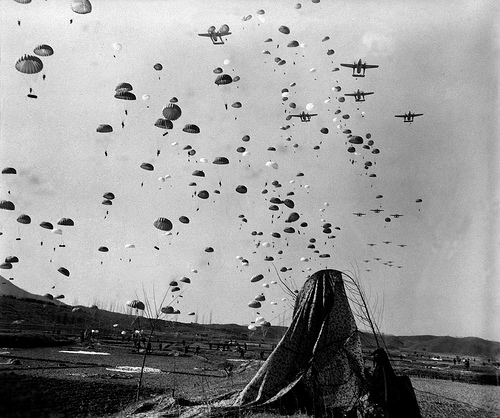
Paratroopers entering Korea. Click to Enlarge. North Korea, Citizens of the Isolated Country
|
|
|
"Two things should be recalled. One is the well-earned reputation for duplicity and dishonesty possessed by the USSR, the other is the slowness with which deliberative bodies such as the Security Council produce positive action. I desire that you personally assure yourself that all elements of your command are made aware of the danger of such a relaxation of effort and that you insist on an intensification rather than a diminution of the United Nation's action in this theater."
- General Ridgway, on moving towards negotiations with the Communist forces on the Korean Peninsula, June 23, 1951 |
"A lot of the ideology of the country is rooted around these oppositions to external and foreign control, first Japanese then replaced in a sense by the Americans, and the quest for independence, and an independent identification, is very strongly related to the idea of the opposition of the southern half, which is very much in the Western camp, and controlled by outsiders, ... and corrupt, and so forth."
- Stephan Haggard, Lawrence and Sallye Krause Professor of Korea-Pacific Studies at UCSD
- Stephan Haggard, Lawrence and Sallye Krause Professor of Korea-Pacific Studies at UCSD