Human Rights
“I had no concept of human rights. I was only destined to live and die in this camp. We were always hungry, and the guards always told us ‘through hunger you will repent’.
- Shin Dong-Hyuk, Former North Korean Prisoner
- Shin Dong-Hyuk, Former North Korean Prisoner
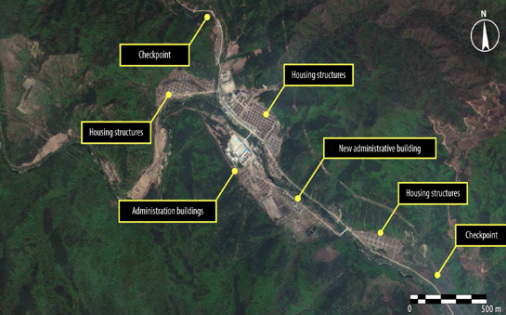
Political Prison Camp No. 16, Myonggan, North Hamgyong. U.S. Committee for Human Rights in North Korea
North Korea does not grant its people the basic human rights to freedom of thought, speech, or information. Juche does not guarantee human rights; it instead proposes a submission of rights for the collective success of the nation.
|
An anonymous Korean woman comments on the human rights situation in the DPRK. The Secret State.
|
"The commission finds that there is an almost complete denial of the
right to freedom of thought, conscience and religion, as well as of the
rights to freedom of opinion, expression, information and
association...The State operates an all-encompassing indoctrination
machine that takes root from childhood to propagate an official
personality cult and to manufacture absolute obedience to the Supreme
Leader (Suryong), effectively to the exclusion of any thought independent of official ideology and State propaganda."
- UN Commission of Inquiry on Human Rights in the Democratic People’s Republic of Korea, 2014 |
|
"People in the facility were beaten every day with sticks or with fists. In the evening, they had to make time for an "ideological struggle" ... This was an official time for the inmates to fight with each other, and the guards indirectly provoke violence. The prisoners had to endure physical punishments ... There were many different ways of beating. Those who attempted to escape ... [had] their hands tied behind their back and they were hung on the wall for three to seven days. They were handcuffed and guards would stomp on the handcuffs ... I witnessed these types of atrocities quite often."
- Mr. Lee K, Former Prison Guard |
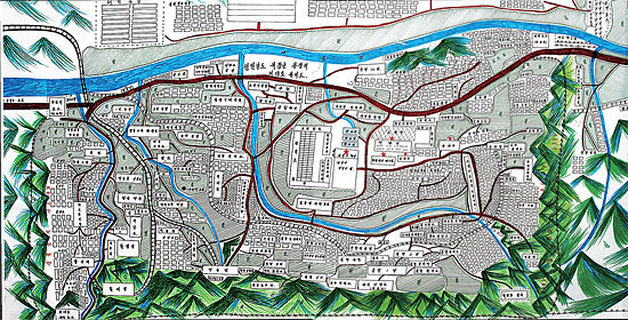
No.18 Camp at Bukchang drawn by Kim Hye-suk
|
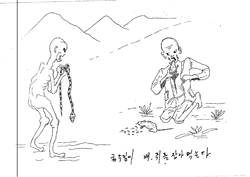
Prisoners forced to eat snakes and rats. Shin Dong-hyuk
|
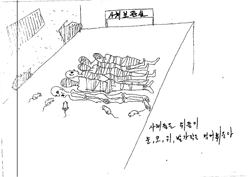
Dead bodies being eaten by rats. Shin Dong-hyuk
|
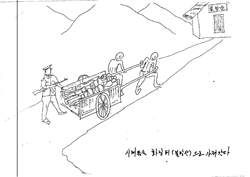
Forced labor at a kwanliso. Shin Dong-hyuk
|
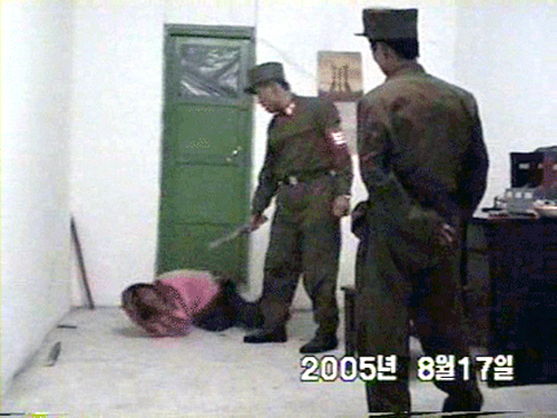
North Korean guards beat a defector that crossed back into the DPRK from China. Daily NK
|
North Korea runs a system of forced labor and political prisoner camps known as kwanliso. Within the camps, inmates suffer routine beating, starvation, and torture.
"Article 5.
- No one shall be subjected to torture or to cruel, inhuman or degrading treatment or punishment. Article 13. - (1) Everyone has the right to freedom of movement and residence within the borders of each state. - (2) Everyone has the right to leave any country, including his own, and to return to his country." - The Universal Declaration of Human Rights |
"Malnourishment made life ... very difficult ... We were always hungry; and restored to eating grass in spring. Three or four people died of malnutrition. When someone died, fellow prisoners delayed reporting his death to the authorities so that they could eat his allocated breakfast."
- Kim, Former North Korean Prisoner
- Kim, Former North Korean Prisoner