Glory Days
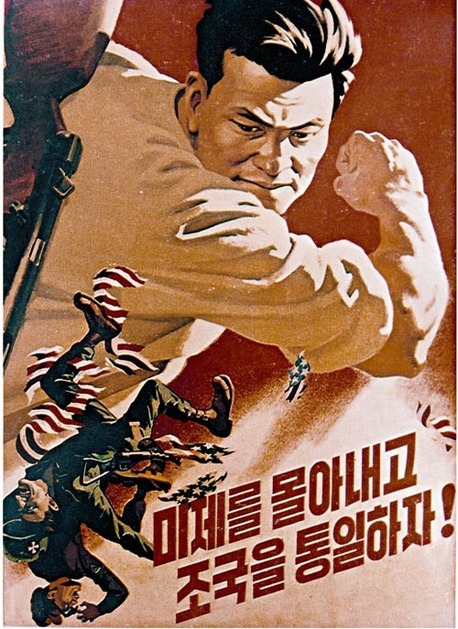
North Korean propaganda poster captioned "Let's drive the U.S. imperialists out and reunite out fatherland!" Mt. Holyoke College
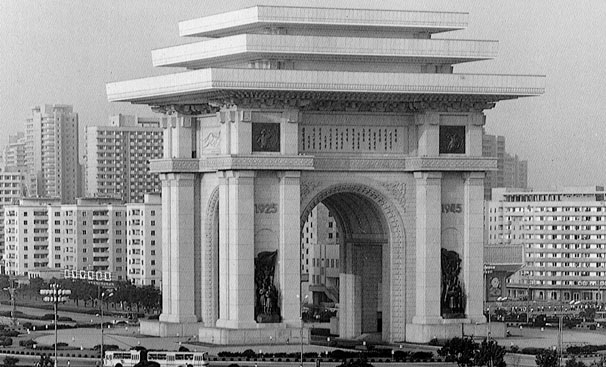
The "Arch of Triumph" in Pyongyang, built in 1982. Library of Congress
"Due to the party's correct economic policy, it became possible to grow in 1949 overall production in industry by 3.4 times compared to 1946. During the same period the grain harvest increased by 139.9 percent. This improved living standards of the population significantly."
– Third Party Congress of the Korean Worker's Party, April 24-30, 1956 |
With help from Soviet and Chinese aid, North Korea was the second richest Asian country in 1950, and was wealthier than South Korea for almost three decades. Aided by the prosperity of the period, Juche became more firmly entrenched in the social ideals of North Korea.
"The Juche idea is the precious fruit of the leader's profound, widespread ideological and theoretical activities, and its creation is the most brilliant of his revolutionary achievements."
– Kim Jong-Il, National Seminor of the Juche Idea, March 31, 1982 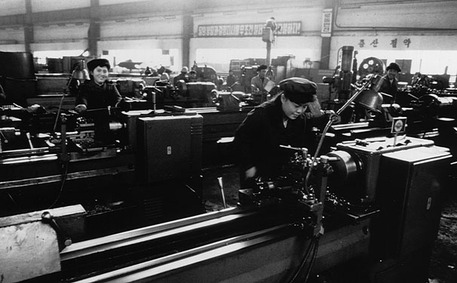
Taean Heavy Machinery Complex. Library of Congress
"In the past decade during the implementation of the [Seven-Year] plan, our industrial production has grown at an average annual rate of 12.8 per cent."
– Kim Il-Sung, On Present Political and Economic Policies of the Democratic People's Republic of Korea and Some International Problems, January 10, 1972 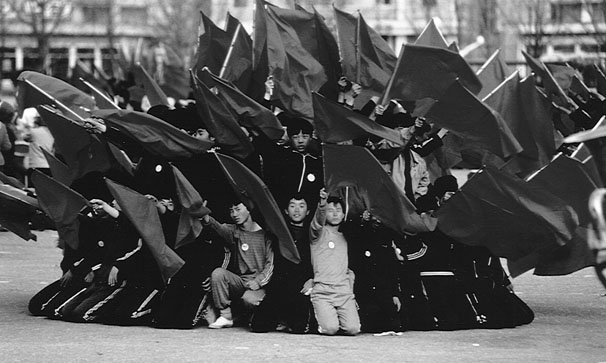
Students celebrating the eightieth birthday of Kim Il-Sung in Kim Il-Sung Square, Pyongyang. Library of Congress
|
"At Present, we are confronted with the honorable task of modeling the whole society on the Juche idea."
– Kim Jong-Il, On the Juche Idea, March 31, 1982
– Kim Jong-Il, On the Juche Idea, March 31, 1982
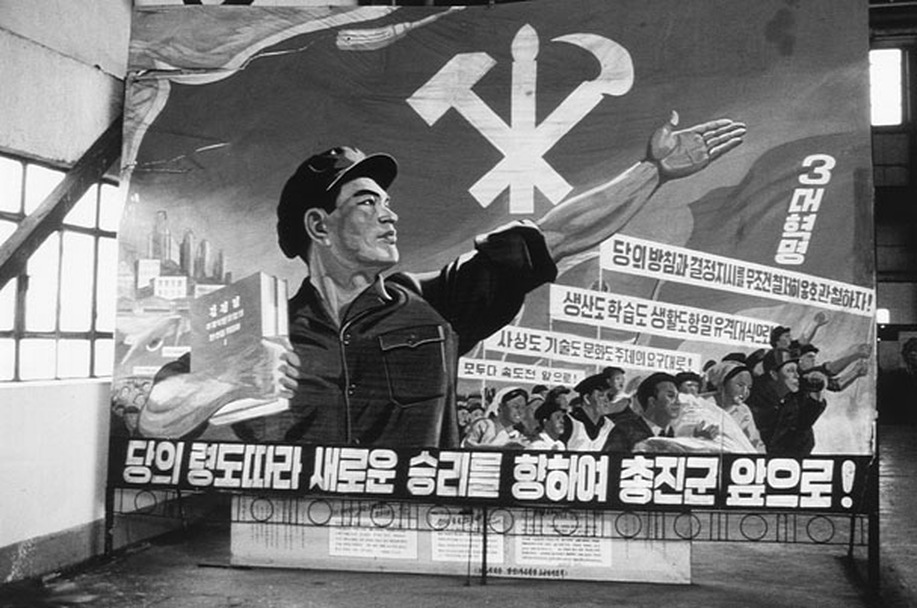
This pro-party poster at the Taean Heavy Machinery Complex urges workers to support the party and purse victory under the banner of Juche. Library of Congress
Interactive Timeline featuring important events in North Korean history from 1945 to 1954. Courtesy of Timetoast
|
Pictures of Kim Il-Sung, the Dear Leader, in the 1960s. Britannica Image Quest
|
"...Can I just clarify something? North Korea, up until the 70s, was a rich, successful, industrial country; it was more advanced than South Korea. And then what happened was the Soviet Union basically fell and cut [North Korea] off. China pretty much cut them off to the extent that they started expecting market prices for the commodities." - Susan Shirk, Ho Miu Lam Professor of China and Pacific Relations at the School of International Relations at UCSD |